
Including our favorite personalized promotional ceramic drinkware.
October 8, 2026Leo VictorCustom Coffee Mug Printing Methods Explained: Which One Fits Your Logo?
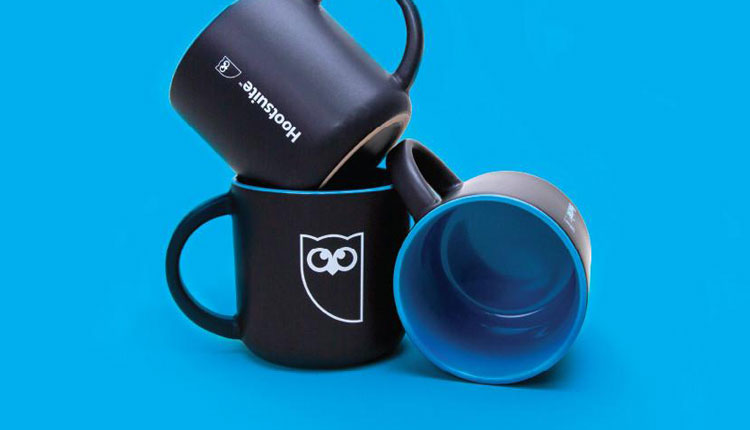
Two mugs can carry the same logo and look nothing alike. One has crisp, bright color that survives years of dishwasher cycles. The other fades after a few months. The difference usually isn’t the mug. It’s how the logo was put on it.
When you order custom coffee mugs, the printing method decides how many colors you can use, how much of the mug you can cover, how long the design lasts, and often how much each mug costs. Here’s how the main methods work and when each one makes sense.
Start with your artwork, not the mug
Before you compare methods, look at your logo and decide a few things:
- Number of colors: One or two solid colors work with almost any method. Gradients, photos, or many colors point you toward full-color options.
- Color accuracy: If your brand relies on an exact color match, mention it early.
- Placement: One side is the most affordable. Both sides make the logo visible to left- and right-handed users. A full wrap turns the mug into a design piece.
Screen printing
Screen printing is the workhorse of promotional mugs. Ink is pushed through a fine mesh screen onto the mug, one color at a time.
It works best for bold, simple logos in one to three spot colors. The colors come out solid and bright, and the price per mug drops quickly as quantities go up, which is why it’s the go-to for trade shows and large giveaways. The trade-off is detail: fine lines, gradients, and photos don’t reproduce well, and each extra color adds cost.
Fired-on (kiln-fired) printing
With fired-on printing, the design is applied to a ceramic mug and then baked in a kiln at high heat. The ink fuses into the glaze and becomes part of the mug’s surface.
This is the most durable option for ceramic, holding up to daily use and repeated washing far better than ink that sits on top. It suits mugs you expect people to keep for years, like employee and anniversary gifts. It usually takes longer to produce, so plan ahead.
Sublimation
Sublimation uses heat to turn special ink into gas, which bonds with a polymer coating on the mug. Because the design becomes part of the coating, it doesn’t peel or crack.
Choose it for full-color designs, photos, and edge-to-edge wraps. It only works on specially coated mugs, which are usually white or light-colored, so dark mugs aren’t an option. It’s a strong pick for event commemoratives, team photos, or any mug where the design is the point.
Full-color digital printing
Digital printing applies full-color artwork directly to the mug’s surface, much like a printer on paper. It handles gradients, small text, and multi-color logos without the per-color setup screen printing needs.
It’s a practical middle ground when your logo has too many colors for screen printing but you don’t need a full photographic wrap. Durability varies by product, so check the care instructions on the specific mug.
Laser engraving
Laser engraving removes a thin layer of a mug’s coating or surface to reveal the material underneath. Nothing is printed on, so nothing wears off.
It’s most common on stainless steel and metal mugs, where a powder-coated mug engraved down to the steel gives a clean, two-tone look. The result feels premium, which makes it popular for executive and client gifts. The limitation is color: the design shows in the color of the material underneath, not your brand colors.
Etching on glass
For glass mugs, the logo is often etched into the surface for a frosted look. Like engraving, it’s permanent and won’t fade, but it’s a single, subtle tone rather than full color.
Printing methods at a glance
| Method | Colors | Durability | Best for |
| Screen printing | 1 to 3 spot colors | Good | Large orders, simple logos |
| Fired-on | Limited | Excellent | Long-lasting ceramic mugs |
| Sublimation | Full color | Very good | Photos and full wraps |
| Digital printing | Full color | Varies | Multi-color logos |
| Laser engraving | One tone | Permanent | Stainless steel gifts |
| Glass etching | One tone | Permanent | Glass mugs |
Matching the method to the mug
Different mug styles pair naturally with different methods. Classic ceramic mugs work with screen printing, fired-on, digital, or sublimation, depending on the finish. Spooner mugs, which come with a spoon tucked into the handle, are usually screen printed. Insulated travel mugs are often laser engraved because they’re stainless steel underneath.
To make the mug feel like a full gift, pair it with branded coffee, tea, and hot chocolate or choose a ready-made drinkware gift set.
Artwork tips that save time and money
- Send a vector file (AI, EPS, or vector PDF) to keep edges sharp at any size.
- Keep fine lines and small text a reasonable size, since thin details can blur with screen printing and engraving.
- Share Pantone references if color accuracy matters.
- Review the proof carefully for spelling, placement, and which side the design sits on.
Ready to design your mugs?
Browse the full range of custom coffee mugs, or call a promo specialist at 888-994-PROMO (7766). Tell them about your logo, your quantity, and how long you want the mugs to last, and they’ll recommend the printing method that fits.