

A style guide keeps every order, no matter who places it or when, looking like it came from the same company. Without one, you end up with five slightly different shades of your brand color, a stretched logo on last year’s hoodies, and a mismatched booth at your next trade show. Here’s how to build one.
Why Consistency Matters in Company Gear
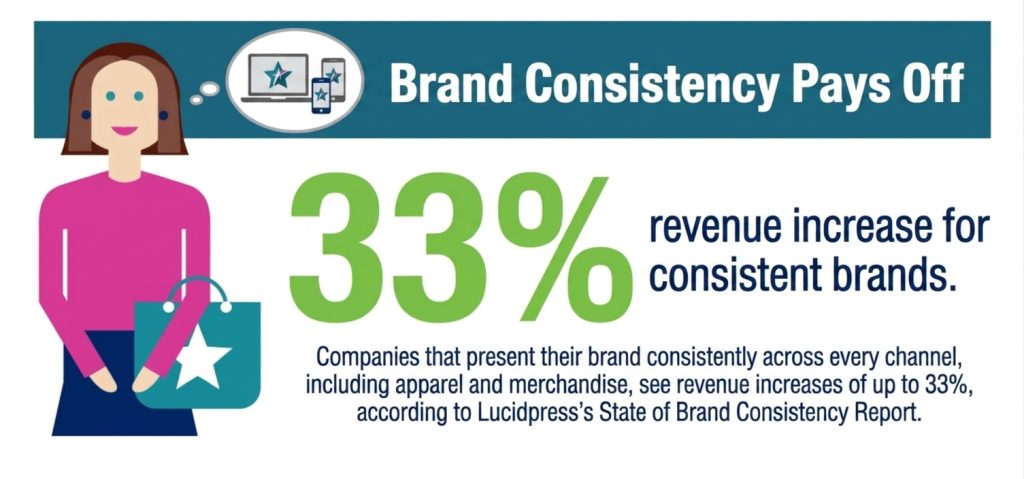
Inconsistent branding costs more than it looks like it does. Companies that present their brand consistently across every channel, including apparel and merchandise, see revenue increases of up to 33%, according to Lucidpress’s State of Brand Consistency Report. The same report found 81% of companies still deal with off-brand content despite knowing it matters. A style guide is what closes that gap: it’s the single reference that keeps every t-shirt, polo, and jacket order aligned no matter who’s ordering it.
Steps to Build Your Branded Apparel Style Guide
A usable style guide covers six things: your core brand elements, your logo rules, your decoration methods, your approved apparel types, your color rules, and your typography. Each one closes off a different way branding drifts over time.
Define Core Brand Elements
Start with the basics every other rule depends on: your primary logo, secondary logo or wordmark, brand colors (with exact hex and Pantone codes), and any brand tagline or mission statement that shows up on gear. Write these down in one place instead of relying on whoever placed the last order to remember them correctly. This is also where you decide which items count as “company gear” in the first place; apparel is the obvious starting point, but the same rules should extend to bags, drinkware, and anything else carrying your logo.
Standardize Logo Rules
Specify minimum logo size, clear space around the logo, and which logo variations are approved for which backgrounds (dark apparel needs a different file than light apparel). Note what’s off-limits too: stretching, recoloring, rotating, or placing the logo over a busy pattern are the most common ways a logo gets mangled on a bulk order.
Choose Decoration Methods
Different apparel calls for different decoration. Embroidery holds up best on structured items like polos, jackets, and caps, and reads as more premium. Screen printing is faster and more affordable for large runs on t-shirts and lighter fabrics, but doesn’t hold up as well over years of washing. Heat transfer and full-color digital printing handle complex, multi-color designs that embroidery can’t reproduce cleanly. Decide upfront which method applies to which apparel type so you’re not making that call order by order.
Select Approved Apparel Types
Not every apparel category needs to be in rotation; a shorter, approved list is easier to keep consistent than an open one. Common categories to standardize include t-shirts, polos, sweatshirts and sweatpants, outerwear, caps and hats, and uniforms and workwear for roles that need daily-use gear. If speed matters for events or new hires, build your approved list around quick ship apparel so timelines don’t force an off-brand substitution.
Define Color Usage and Restrictions
List your exact brand colors in hex and Pantone, plus which apparel colors are approved as a base (not every garment color will reproduce your brand colors accurately). Note any colors that are explicitly restricted – colors too close to a competitor’s brand, or combinations that clash with your logo. This prevents the common problem of a “close enough” garment color slipping through on a rush order.
Include Typography Guidelines
If any apparel includes text beyond the logo- a tagline, a department name, a name badge- specify the approved fonts, weights, and sizing. Typography is easy to overlook on apparel since most of the visual weight goes to the logo, but inconsistent fonts across a team’s gear are just as noticeable as an inconsistent logo.
Summary
A branded apparel style guide is a one-time investment that prevents repeated inconsistency, and inconsistency is expensive, not just unpolished. Cover your core brand elements, logo rules, decoration methods, approved apparel, color rules, and typography, and every future order will match the last one. iPromo can produce any apparel type in this guide with your approved decoration method, and a company store makes it easy to enforce the guide across every department without reviewing each order by hand.